
LABUAN BAJO – Seraya Besar Island is starting to attract the attention of property and hospitality investors because it offers large-scale beachfront land at relatively low prices compared to the premium mainland areas of Labuan Bajo.
Labuan Bajo is no longer solely focused on developing its main destination on the Flores mainland, but is beginning to develop a marine tourism ecosystem that makes satellite islands an integral part of the premium experience.
Seraya Besar is in an attractive position because it offers a combination of scarce coastal land, white sand beaches, privacy, panoramic ocean views, and proximity to the tourist hub of Labuan Bajo that is difficult to replicate on the mainland.
However, this appeal must be read differently from traditional land investments because island assets carry additional risks in the form of sea access, energy, clean water, construction, logistics, conservation, disasters, and liquidity.
Investment Potential and Location: Large Beachfront at the Gateway to Komodo Tourism
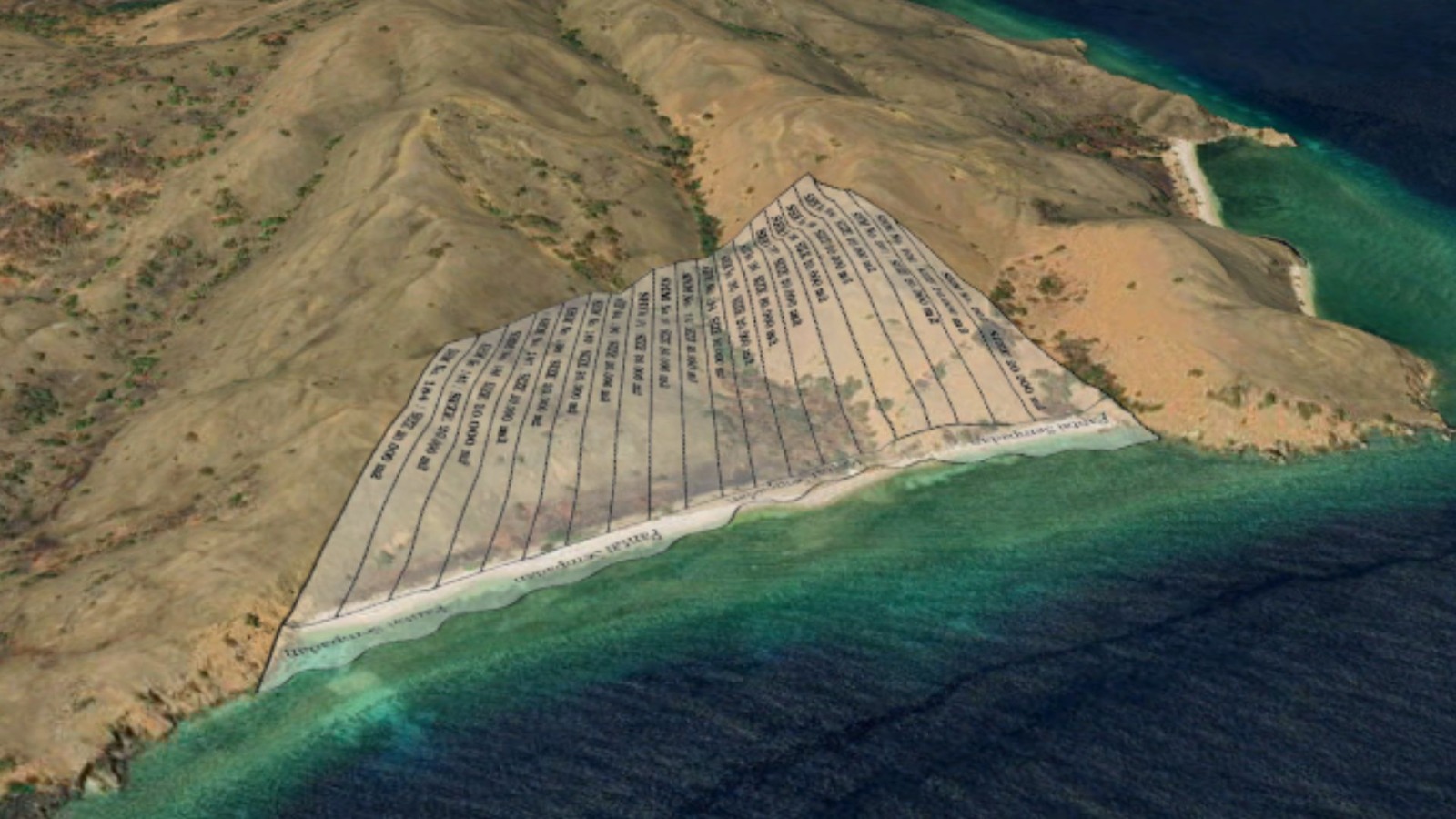
Seraya Besar Island is located in Seraya Meranu Village, Komodo District, West Manggarai Regency, East Nusa Tenggara , including the island region which is administratively within the Labuan Bajo tourism ecosystem.
One of the largest land offers updated in August 2026 recorded an area of approximately 400,000 square meters or 40 hectares with an offering price of IDR 750,000 per square meter, SHM status, and beachfront orientation.
Other listings updated throughout 2026 show price variations of around Rp300,000 per square meter for 48,400 square meters, Rp500,000 per square meter for 9,858 square meters, and Rp650,000 per square meter for 41,000 square meters. This variation indicates that the Seraya Besar market is still in the price discovery stage .
From a development perspective, the large beachfront land character provides flexibility to build low-density resorts, private villas, wellness retreats, boutique hospitality, limited beach clubs, or a combination of hospitality and conservation.
This opportunity is all the more appealing because the island resort concept doesn’t necessarily focus on a large number of rooms. The low-density luxury model allows developers to sell privacy, marine experiences, exclusivity, and proximity to nature as the primary product.
Investors Already In: A Small Proof of Concept
One of the most concrete evidences of the feasibility of the hospitality business in the Seraya cluster comes from Seraya Kecil Island, a neighboring island of Seraya Besar, through the Sudamala Resort, Seraya.
Sudamala Resort, Seraya operates a resort with a barefoot tropical retreat concept and a coral reef conservation program that is an example of how premium hospitality can be combined with environmental protection.
In 2025–2026, Sudamala strengthened the model through an integrated 300 kWp solar energy system with 480 panels and a 770 kWh battery that supplies approximately 80–85 percent of the resort’s operational needs and is projected to produce approximately 410,000 kWh of clean energy per year.
Sudamala Resorts CEO Ben Subrata said at the program launch that the energy transition is part of the company’s commitment to sustainability and is expected to inspire other hospitality operators, especially in remote island locations.
For Seraya Besar investors, the success of the Sudamala model does not automatically guarantee the success of new projects, but it does provide proof of concept that island-based premium hospitality and energy independence can be implemented in the Seraya ecosystem.
Actual Land Price Information: Rp. 300,000–Rp. 750,000 per Square Meter
Verifiable market data in 2026 shows the range of land offering prices in Seraya Besar is around Rp300,000 to Rp750,000 per square meter , depending on the area, position to the coast, access, legality, and character of the land.
With an asking price of around Rp750,000 per square meter , the 40-hectare plot has a market value of around Rp300 billion . There are also options for purchasing plots of 1–2 hectares , allowing investors to tailor the acquisition scale to their capital needs and development plans. Meanwhile, the 41,000-square-meter plot, listed at Rp650,000 per square meter, has a market value of around Rp26.6 billion.
These price differences indicate that investors should not use a single figure as the “market price” for Seraya Besar. Prices should be normalized based on beach frontage , topography, boat access, beach quality, legality, utility availability, and the potential effective buildable area.
For investors, a low price doesn’t necessarily mean a cheap asset. Land worth Rp 500,000 per square meter, requiring significant investment for docks, power plants, desalination, internal roads, waste management, and material mobilization, can have a much higher total development cost .
Conversely, land with a higher entry price but better sea access, more prepared contours, clearer legality, and lower infrastructure requirements can provide more attractive risk-adjusted returns .
Investment Potential for the Next 10 Years: 2026–2036
In a 10-year perspective, Seraya Besar has three main sources of potential value, namely land banking , hospitality development, and value enhancement due to beachfront scarcity.
The first scenario is land banking , when investors purchase land with a long-term horizon and wait for the area’s value to increase due to increased tourism activity, connectivity, and hospitality investment in Labuan Bajo.
The second scenario is direct development into a boutique resort or private villa with a limited number of units so that the economic value comes not only from the increase in land prices, but also from operational income.
The third scenario is a joint venture with a hospitality operator, where the landowner provides the assets while the investor or operator brings the capital, brand, management, and marketing network.
The potential of this model is enhanced by the development of marine tourism around Seraya. In April 2026, Seraya Kecil Island will host the Komodo Ocean Swim 2026, supported by the Indonesian Agency for the Protection of Marine and Fisheries (BPOLBF), as part of strengthening Labuan Bajo’s sports tourism .
The President Director of BPOLBF, in developing the event, emphasized that marine tourism activities can broaden tourists’ experiences and strengthen Labuan Bajo’s image as a marine tourism destination.
However, investors should avoid assuming that institutional investment in Labuan Bajo automatically drives up the price of Seraya Besar. The impact on land prices will depend on the project’s location, connectivity, infrastructure, and the extent of its economic benefits flowing to the island.
The Role of Government: Infrastructure and the Blue Economy Are Key Factors
The West Manggarai Regency Government has included Seraya Besar Island in its territorial structure and designated the Seraya Besar area as a residential area in regional government documents. This demonstrates that island development must consider the needs of the local community in addition to investment interests.
In the West Manggarai sustainable tourism development assessment document, Seraya Island is among the areas with solar energy facilities, along with several other islands such as Papagarang, Messah, and Batu Tiga. This indicates that decentralized energy solutions are indeed relevant for island development.
The local government also has a maritime transportation regulatory framework that lists Seraya Meranu–Labuan Bajo as one of the routes with regional maritime transportation cost standards. This infrastructure and connectivity costs are crucial factors in calculating the operating costs of island projects.
In November 2025, NTT Governor Emanuel Melkiades Laka Lena stated that the solar energy project at Sudamala Resort Seraya demonstrated that tourism development can go hand in hand with environmental protection and the development of a green and blue economy.
For Seraya Besar investors, this policy direction provides a positive signal that future projects combining hospitality, renewable energy, marine conservation, and community empowerment have the potential to be more aligned with the direction of regional development.
Key Risks and Difficulties: Island Premium Must Be Calculated From the Start
The first risk is construction and logistics costs. Building materials, heavy equipment, fuel, workers, and utility components must be mobilized by sea, making construction costs and timelines more difficult to predict than onshore projects.
The second risk is electricity and water. The Sudamala model suggests that solar energy and batteries could be a solution for island resorts, but these investments require initial capital and maintenance systems that must be factored into capital expenditures .
Clean water is also a strategic component. Resort investors need to consider water sources, storage capacity, seawater treatment (if necessary), and wastewater treatment systems before determining the number of rooms to build.
The third risk is legality. Claiming a SHM (Freehold Title) in a listing should not replace due diligence . Investors need to verify the original certificate, title history, parcel boundaries, legal access to the land, spatial planning compliance, coastal status, and potential third-party claims.
The fourth risk concerns the marine environment and space. Seraya Island is located within a sensitive marine ecosystem, so pier construction, ship activities, water intake, waste management, and coastal construction must comply with applicable environmental and spatial planning regulations.
Scenario 2030–2036: Three Possible Futures of Greater Asia
The Base Scenario predicts Seraya Besar will gradually develop as a boutique hospitality destination with a limited number of projects. Land prices have the potential to rise in line with Labuan Bajo’s growth, but this increase remains highly dependent on infrastructure and demand.
The upside scenario occurs if maritime connectivity improves, premium resort investment increases, energy and water can be provided at competitive costs, and Labuan Bajo succeeds in increasing the length of stay and spending of premium tourists.
In this scenario, Seraya Besar could evolve from mere land banking to a low-density luxury hospitality cluster with added value derived from property development as well as operational income.
A downside scenario occurs when development costs are too high, sea access is inconsistent, resort supply increases faster than demand, environmental regulations become stricter, or disaster risks increase insurance and financing costs.
Under these conditions, investors who rely solely on rising land prices will face higher liquidity risks than investors who have a development strategy and operational cash flow.
Investment Strategy: Who is Best Suited to Enter Seraya Besar?
Seraya Besar is more suitable for investors with a minimum horizon of seven to ten years who understand the character of illiquid assets and have the ability to bear long-term development costs.
Individual investors can consider land banking strategies on land with strong legal standing and strategic positions, while corporate investors can explore joint ventures for the development of resorts, wellness retreats, or conservation-based hospitality.
Hospitality developers have the greatest opportunity if they can combine low-density design with energy independence, water management, marine conservation, and a premium tourism experience that differs from land-based resorts.